Seven days and seven nights...hey, that's a week! Multiply by four and you've got the duration of our Bad Moon Rising deep dive. It's an album and era I haven't explored much while working on these Song of the Week features, despite being one of my favorite Sonic Youth records. We'll analyze that at some point. For now, let's go back to the "Early Sonic" era I covered, which essentially wrapped up with a CBGB gig in December 1983. The band had returned from their second European tour, culminating with a disastrous but critically championed gig in London on December 1st. They wouldn't make another live appearance until May of 1984. Thurston explains in the October 1984 Forced Exposure interview that serves as the narrative device for the Early Sonic piece:
"[A]fter we got back from Europe the second time, we decided that we were tired of doing the same old set - the CONFUSION IS SEX set - and we just stopped to cool out. We stopped playing for a few months. People thought we'd broken up, but we still rehearsed. We took all the strings off the guitars, threw them around a little bit, put some strings back on them and hammered them a little bit, so there was really no way we could play those songs. We killed those songs. We could never do them again. So we wrote a whole new batch of songs that turned out to be more subtle. Songs that were a little bit more laid-back physically. More cerebral kinds of songs. [...] So we wrote seven songs - which happen to be all the BAD MOON RISING songs - and we said, "Let's do a set that doesn't stop so much." A lot of times in the past we've had trouble between songs. There'd be a good five minutes of setting up 'cause we had so many different guitars. So we figured we'd plan our segueways [sic] from one song right on to the end. And we worked on that as much as we did the songs - the segueways as bits unto themselves."
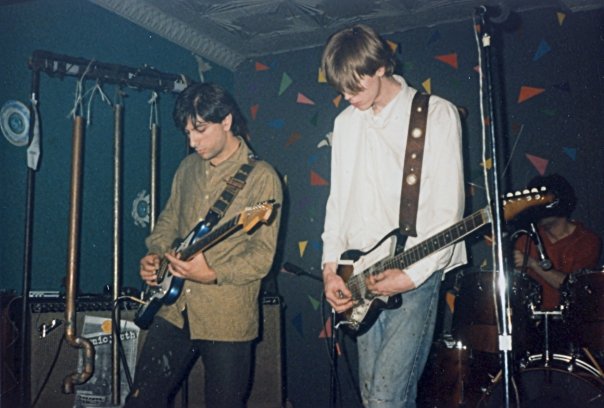
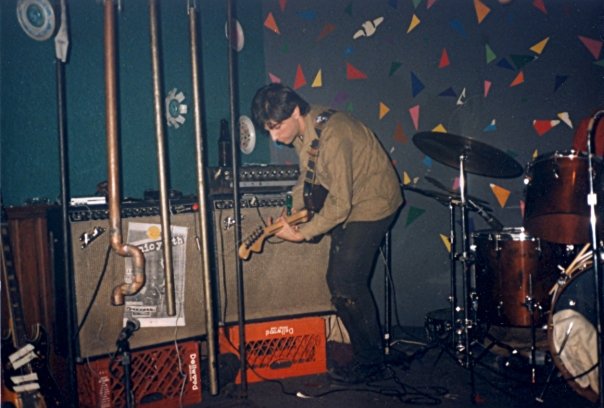
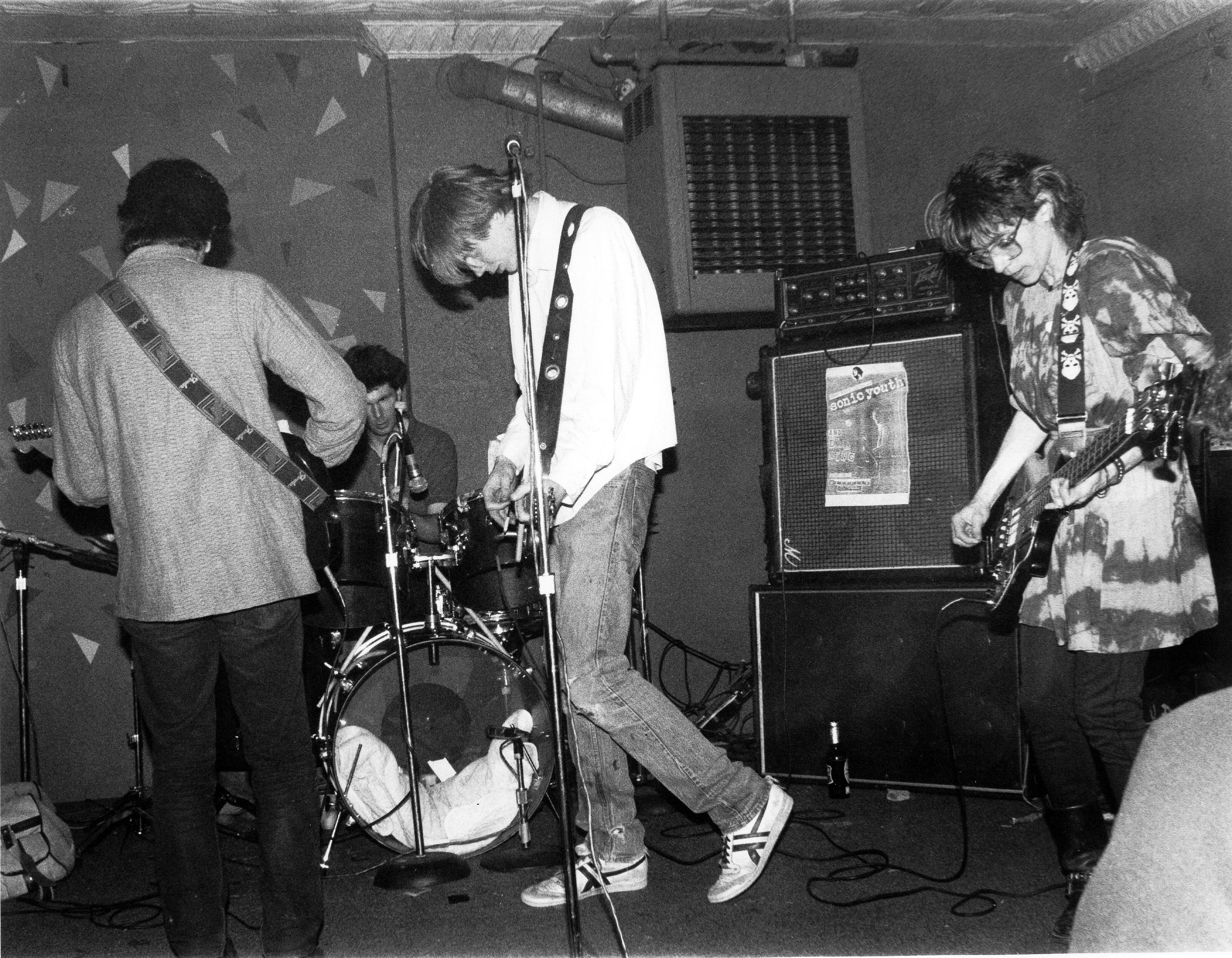
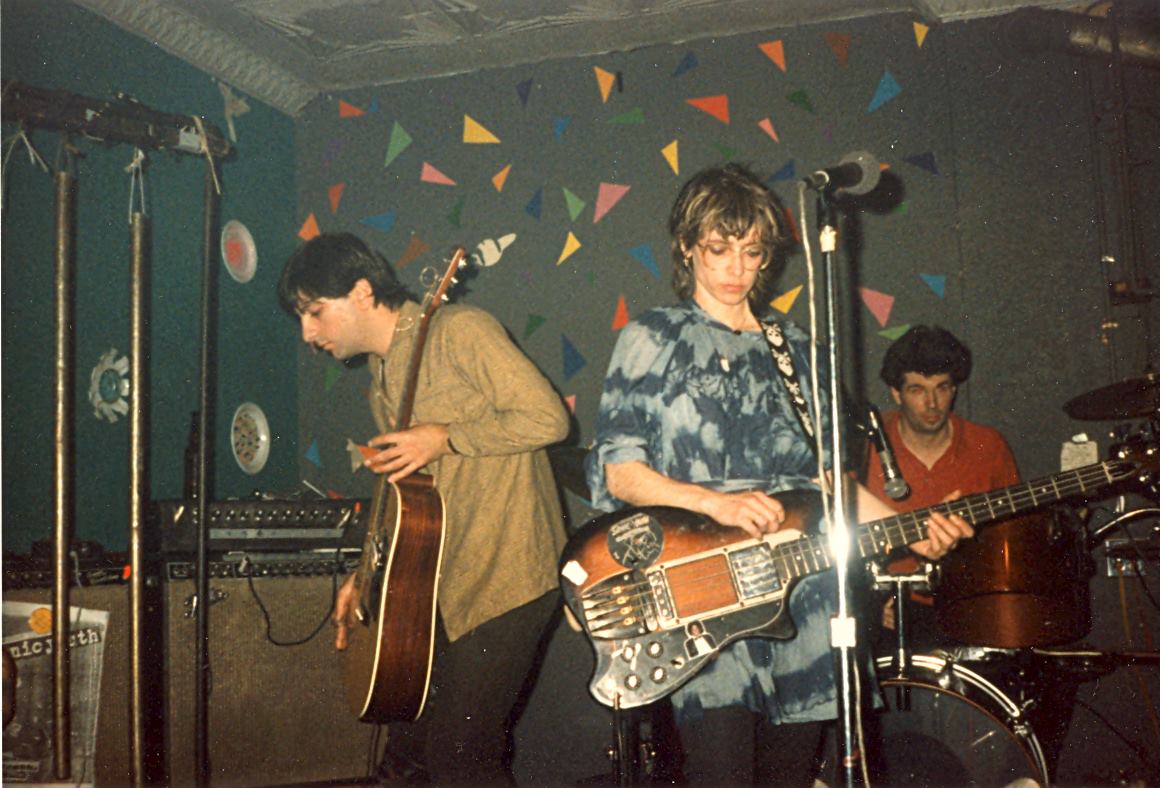
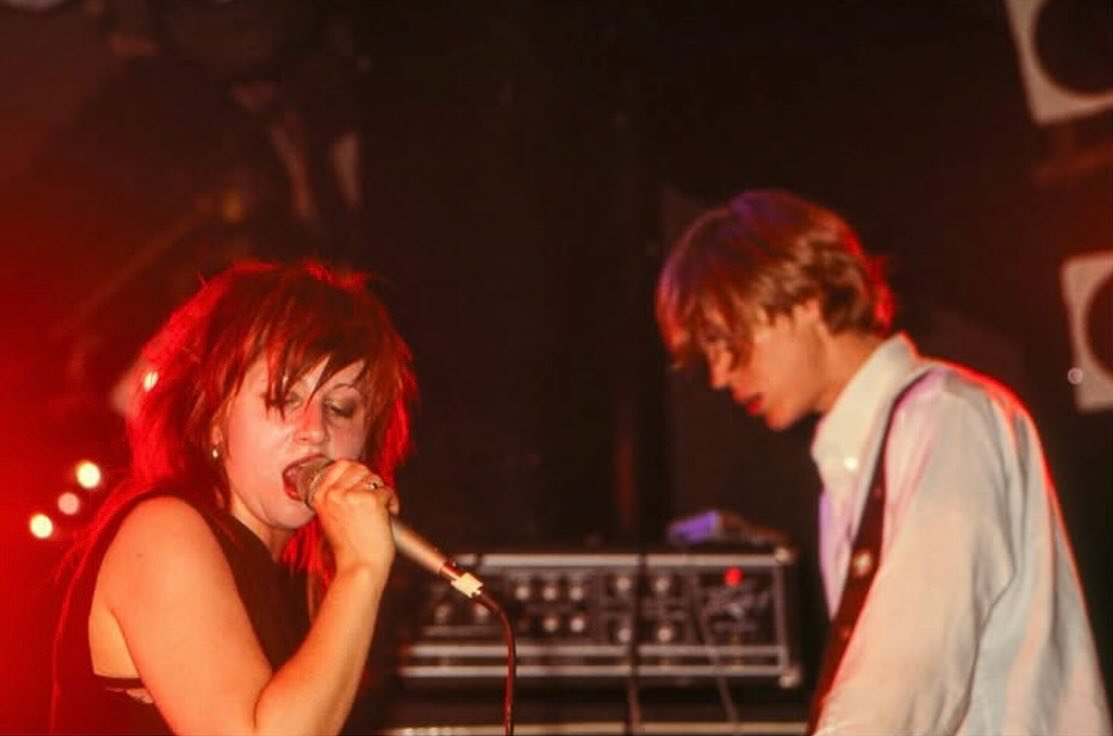
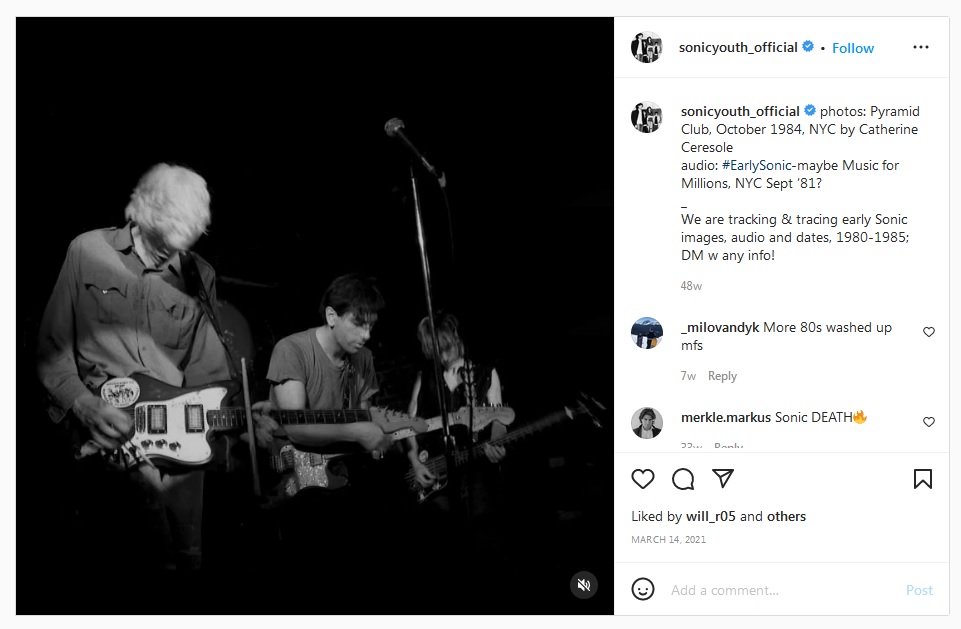
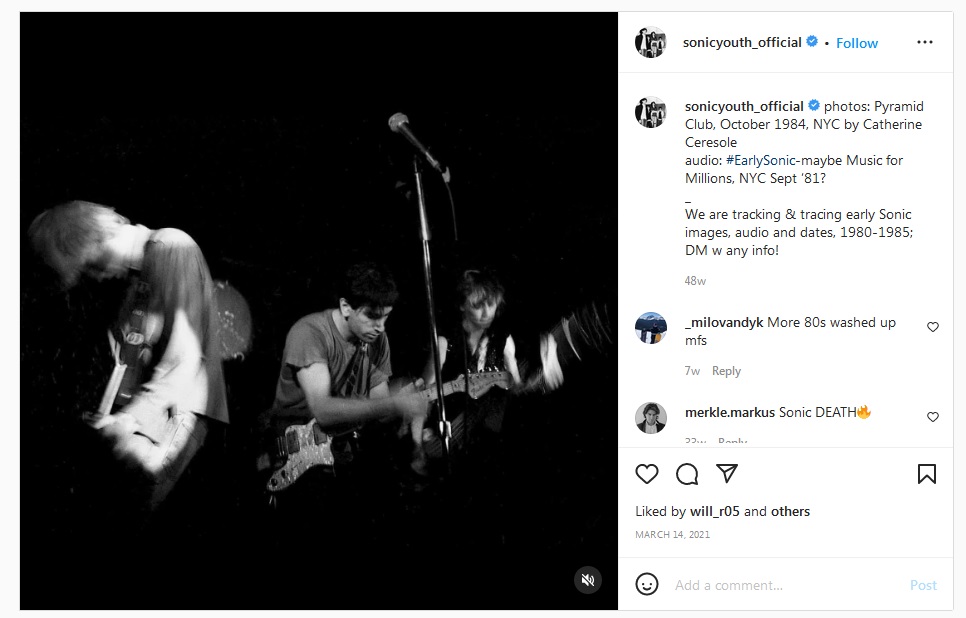
They wrote the songs that would become Bad Moon Rising in the basement of the Plugg Club on 24th St in NYC. They debuted the suite of material on May 19th at Maxwell's in Hoboken, New Jersey. Luckily, a recording of the show exists, and a handful of pictures. Some are credited to Linda Wolfe, and I know one not featured here was taken by Catherine Ceresole and published in her awesome book. We'll talk more about these crazy pictures later.
Something extra special from the Bob Bert collection: a flyer for this gig with the set list written on the back!
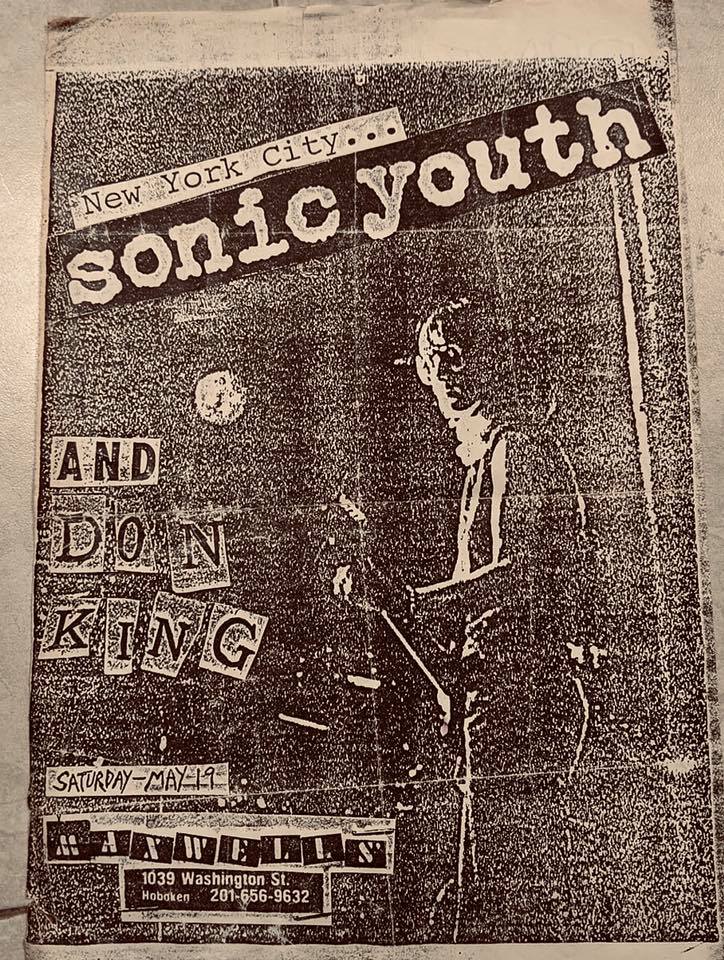
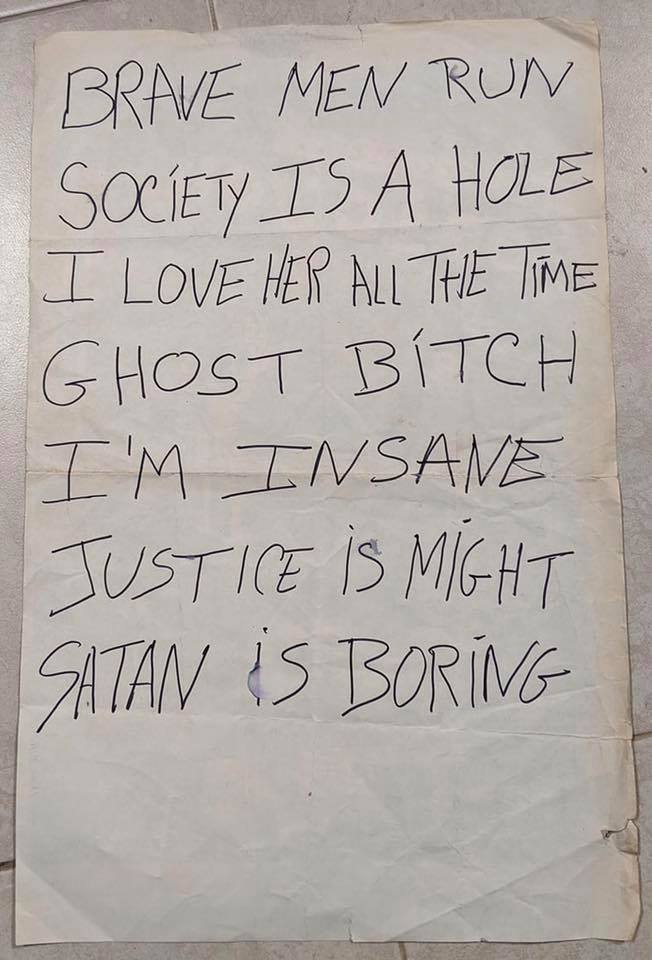
You'll note that "Death Valley '69" is absent, and indeed of the seven known shows played in 1984, "Death Valley '69" wouldn't appear until the fourth, on June 30th at Danceteria. Here, it followed "Satan is Boring" to close the evening, and featured guest vocalist and co-writer Lydia Lunch. The next available set list is again at Maxwell's on October 24th, where "Death Valley" has now been inserted between "Society is a Hole" and "I Love Her All The Time", presumably because it shares a tuning with the former. For what it's worth, I've also heard that "Death Valley '69" was written earlier, in Mike Gira's rehearsal space. They thought it sounded like Steppenwolf and were hesitant to jam on it, but once it revealed its potential they stuck with it. Since it wasn't built into the original set list, tacking it on to the end of the album made the most sense. It replaced "Satan is Boring" in the original running order, which was relegated to b-side of the Death Valley EP.
In July 1984 they recorded "Death Valley '69" and "Brave Men Run" at Wharton Tiers' studio, which was released as a 7-inch on Iridescence later that year. The band was technically without a label, having financial issues with Neutral and their German label Zensor. Future Matador Records kingpin Gerard Cosloy expressed his interest in releasing their next album on his new Homestead label, while a fellow named Paul Smith worked incredibly hard to release the band's music in the UK, eventually creating his own Blast First! imprint to do just that. While Sonic Youth's time with Homestead was brief, moving on to SST for the next couple of albums, they stuck with Blast First as their European label until signing with Geffen in late '89.
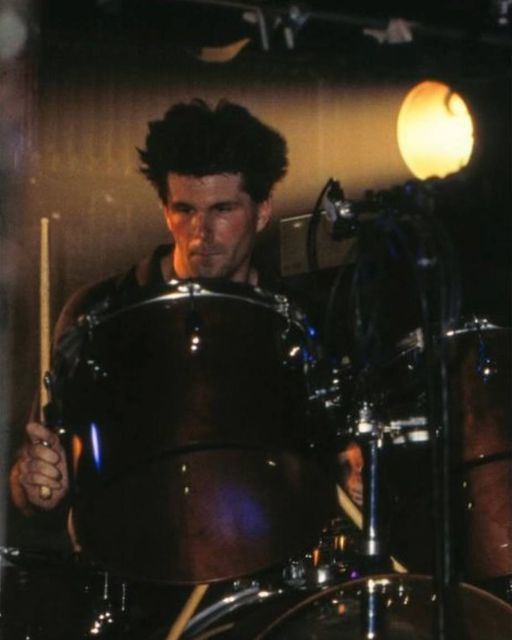
They decided to record the album on 24-track at Martin Bisi's studio, where they would return for EVOL. According to Confusion is Next, the album was "recorded for under $7000 in a little more than a week's time". The vinyl sleeve lists the recording dates as September-October while the CD says September-December. I'd lean towards the former. Bad Moon Rising was released in March 1985, and the band toured Europe and North America extensively, switching drummers along the way. We'll look into these tours as we go, while focusing on 2-3 songs each week. Every installment will have its own tangents and hopefully do justice to one of the most important eras of the band's history.
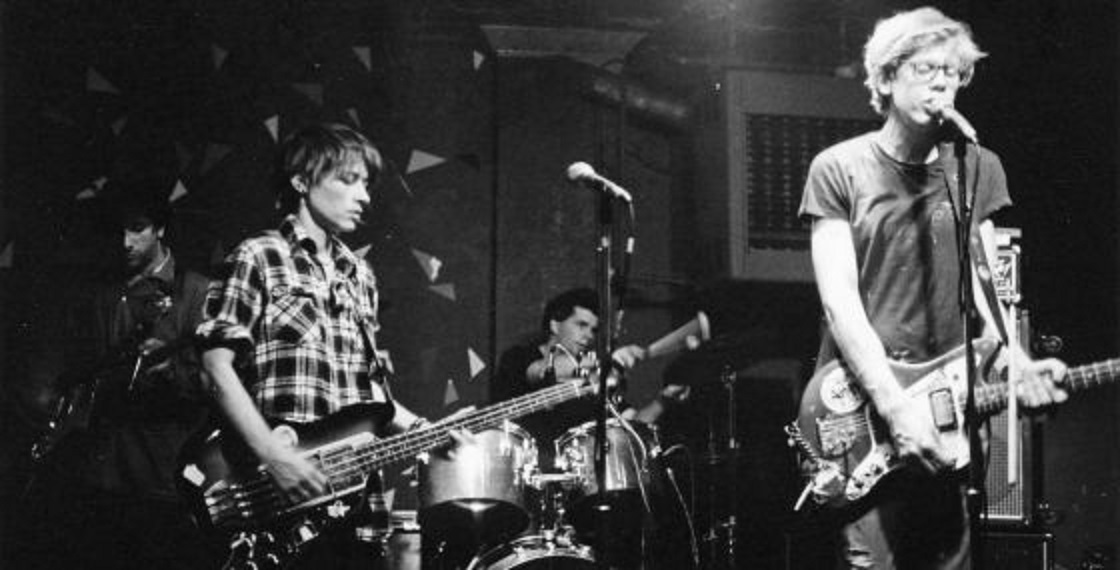
The album is a reflection of the set as performed at those scarce 1984 gigs. The elegant "Intro" sets a much different tone than the atonal bash that opens "She's in a Bad Mood". Then "Brave Men Run" drops and it's got a bunch of cool parts and wild sounds and eventually a great Kim vocal. As its final harmonic overtones fade, a tape loop constructed from Lou Reed's Metal Machine Music LP slides in, then the bassline for "Society is a Hole" begins, with the rest of the band soon to follow, Thurston on the mic this time, all with Lou simmering under the surface. As "Society" winds down, a jarring blast of sound joins the party, a spliced up version of "Not Right" by the Stooges. During concerts, Lee would play these tapes from his amp either as backing tracks or to provide segue assistance while switching guitars and tuning.
Thurston's drumstick rumbling interrupts the Stooges and forces them out with a violent roar that leads to "I Love Her All The Time". Thurston once again takes the vocal lead. Technically the vinyl flips here, but it's a fairly seamless transition from the fading feedback whine that closes "I Love Her" to the long, low drones that set the stage for "Ghost Bitch". Lee breaks out the acoustic guitar to offer a whole new kind of feedback, sounding off like a foghorn against Thurston's demonic whammy bar responses. Kim offers a slow, measured vocal that builds to Bob's pounding entry. Thurston's guitar shrieks through the outro before the inane stomp of "I'm Insane" kicks in. At this point in the live set, Thurston goes for the remainder of the performance without a guitar, as far as I can tell. I believe there are multiple tape loops playing through the song on the album, and at least one was used live.
As "I'm Insane" wraps up, Thurston starts speaking through a very distorted microphone, which also loudly feeds back. Live, he would kind of address the crowd and assess the stage situation, but on the record his fuzzy recitation is inspired by a Lydia Lunch poem called "Sex Maniac" and of course, Sonic Life. Lee starts playing a bright, chiming open string melody, the band kicks in, and Thurston sings a proper verse. Live, the song would dissolve and Thurston would introduce "Satan is Boring" as the final song, sparking one last tape loop and a lot of chaos. On the record, "Death Valley '69" follows "Justice" and makes for a stunning closer. After 1984, they stopped performing the album in its exact running order (and stopped playing some songs entirely), but continued to adopt the segue motif throughout their sets, via cassettes or instrumental passages.
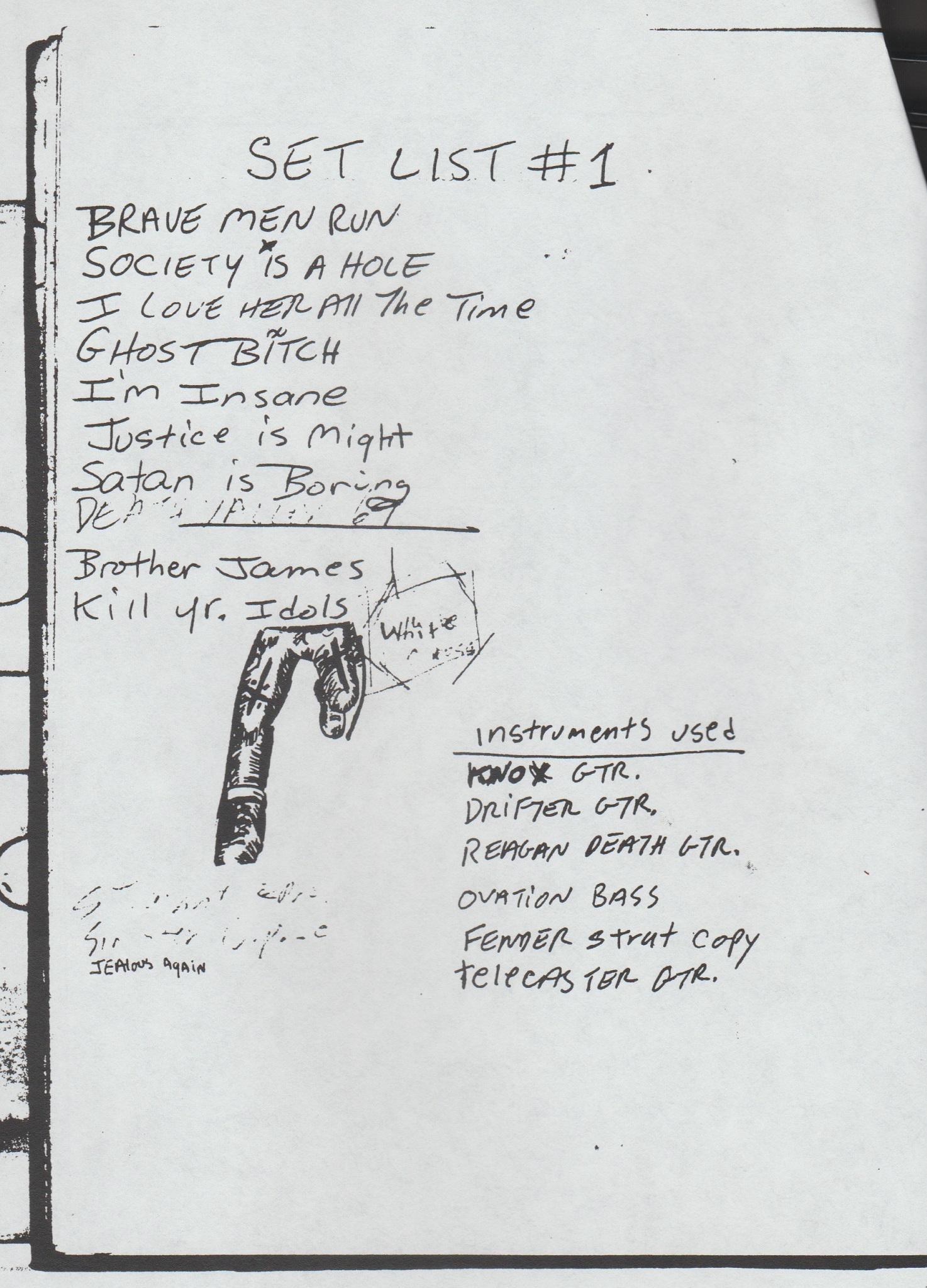
This is one of my favorite sonic documents becuz it invites so many questions. It's taken from Thurston's journals, and based on the title it would seem to be a set list circa May 1984. Note how "Death Valley" is following "Satan". I suppose since many of the (few) 1984 tapes cut during "Satan is Boring" there's no way of knowing whether they did the double shot of Kill Yr Idols tunes, and that early "White Cross" has always stumped me. We'll get back to that, though.
I've already discussed this, but the three songs you can faintly read are all covers the band never fulfilled, yet are all mentioned in the Forced Exposure interview: "Straight Edge" by Minor Threat, "Sinister Purpose" by Creedence Clearwater Revival, and "Jealous Again" by Black Flag (okay, they mention "Rise Above", but two outta three ain't bad).
Forced Exposure: "We heard that you were going to be doing a cover of "Straight Edge" as a single."
Thurston: "Yeah, we still wanna do it. The idea of doing it came about when I was trying to think of songs that nobody in their right mind would ever do - 'Straight Edge!' I mean, that song is so sacred that nobody'd ever do it. They'd do 'Rise Above' before that. And unless they're trying to be mindless MAXIMUM idiots they'd never do 'Rise Above'. So I figured that if anybody was gonna do it, it might as well be us."
Forced Exposure: "Are you doing any more unoriginals right now?"
Thurston: "Well, we do a cool 'Sinister Purpose' but, since Redd Kross put out their rock and roll retrospective, the idea of recording covers's kind of used up. There's a song we do called 'Blooze Blurrr' that's nine minutes long. We recorded it on a binaural head and submitted it to a NY thing called THE SIN CLUB COMPILATION, which has the False Prophets, Live Skull, and buncha bands that played the Sin Club. We said 'Here. You can have this.' They listened to it and said, 'What the fuck is this? This isn't Sonic Youth.' We said 'Yeah it is.' And they wouldn't release it, but the guy who was gonna put out the album died a few weeks ago anyway, so..."
I'll never resist any opportunity to focus the conversation onto "Blooze Blurrr", and this passage from Thurston will always haunt me. Anyway, back to the set list. If I may tip my hand, one of my goals with this Bad Moon exposé was to confirm my belief that the CD liner notes are full of red herrings in the form of non-relevant tunings, and perhaps to myth bust this idea that the band was using a dozen guitars and tuning endlessly between songs. There's some stuff that doesn't add up. Looking at the six instruments itemized here, I will say there are some curious omissions. In the live photos featured above, the Ovation bass, Knox, and Telecaster are all visible. I wonder if the "Fender Strat Copy" is the blue Jazzmaster copy? I'm not aware of any other Strat copy, and that blue Jazz was definitely a key instrument in this era and beyond. Where is the Favilla acoustic that drives "Ghost Bitch"? Where is Lee's Kent, seen sidestage at Maxwell's, a requirement if they were doing "Brother James"? Presumably that's also what Thurston's "Reagan Death" (the infamous white Gherson SG copy) was for. And the Drifter?! It disappeared between being beaten for "The Burning Spear" in '83 to emerging with a four-string makeover as the harmonic backbone of "Marilyn Moore" in 1986. Could it be part of the fabric of Bad Moon Rising?
Let's get to the first three songs of the album. "Intro" does a lovely job living up to its name, an instrumental track of four dreamy guitars that is hard to separate from the beginning of "Brave Men Run". But look at the sleeve, it's right there! Even I got tired of listing "Intro" as a separate track in the Concert Chronology, with its implied inclusion in "Brave Men Run". As far as I know, they always performed both, though the 7" demo version of "Brave Men Run" notably starts directly with the full band!
In Girl in a Band, Kim writes: "From the few stories I'd heard, the women in my family were incomprehensibly strong. My great-grandmother who sold sewing patterns up and down the West Coast in the 1800s. My grandmother, traveling all over with a brood of five kids, finally landing in Kansas during the Great Depression. Stoic, enduring, no questions, no complaints. When I sang 'Brave Men Run (In My Family)', I was singing about those women. The song's phrase 'Into the setting sun' refers to the westward pull, the American romance with death."
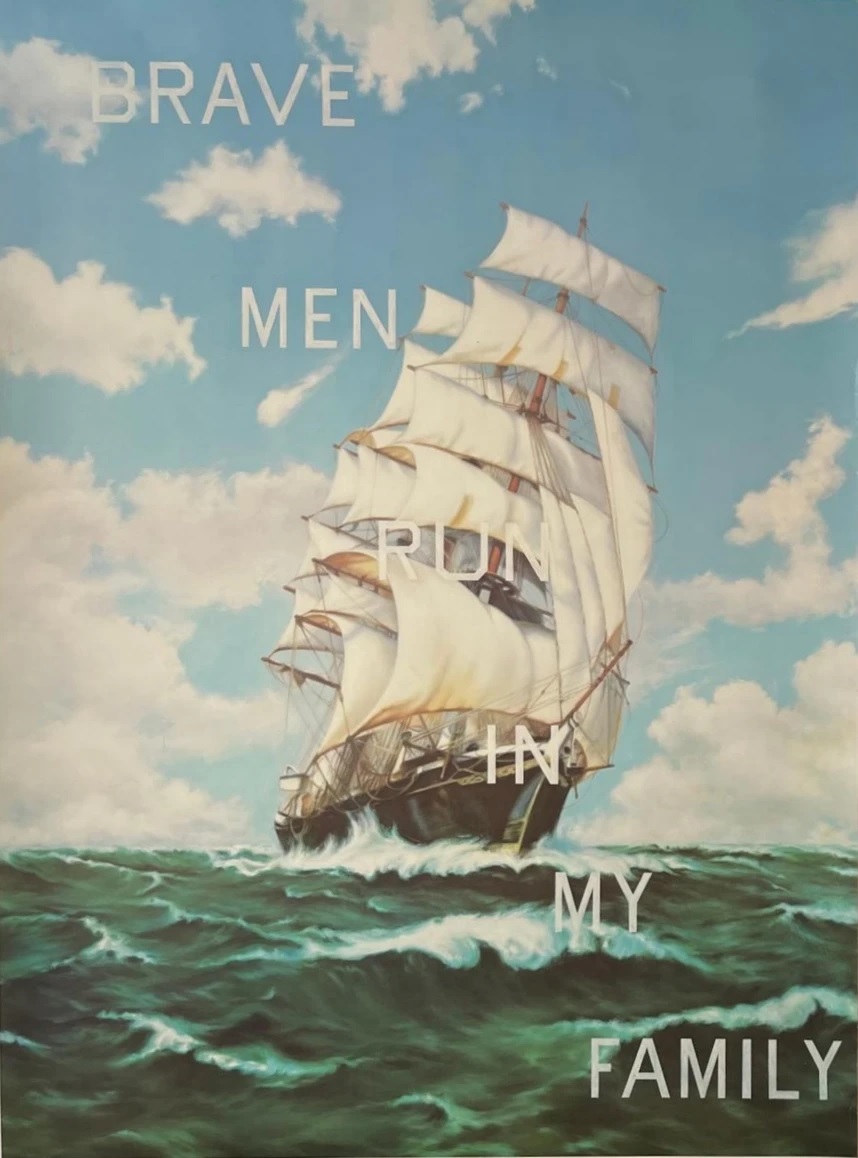
The title is taken from an Ed Ruscha painting:
Goodbye 20th Century notes an incident where Kim protested against changes to her bass part suggested by Thurston, and stuck with what she'd written. It certainly works! The "Intro"/"Brave Men Run" combo opened all 1984 shows (except perhaps October 27th at the Pyramid, where they premiered "Halloween", a song they'd written at soundcheck). Indeed "Halloween" usurpsed its opener status for much of 1985, along with "Brother James" and even the occasional "Society is a Hole". "Brave Men Run" usually popped up second or third, paired with "Death Valley". The late '85 European tour typically had a "Green Light" opener, with an encore of "Brave Men Run" and "Death Valley". They performed it for the last time (*ASTERISK*) on November 9th, 1985 in Ladbroke Grove (*ASTERISK*), though it did pop up in the soundcheck on June 24th, 1986 in Atlanta, Georgia. They didn't play it that night or any other circulating night, but the footage appears in the EVOL tourfilm. The second asterisk pertains to a potential bad ID on the Ladbroke Grove gig, but I'm going to save that for later. The first asterisk, well, on August 12th, 2011, in Brooklyn, NY, they opened with "Intro"/"Brave Men Run", making it the longest hibernation for any Sonic Youth song, ever (26 years!). It was unexpected to say the least, as was the sad announcement shortly thereafter that the band would be going on hiatus, one which continues to this day. With five South American festival gigs already agreed to, they wrapped up their sonic life in November 2011, and indeed opened with "Brave Men Run" one last time at their final show.
A live version of "Brave Men Run" recorded in Chicago on August 11th, 1985 was initially released via the "Buy Early, Get Now" promo for The Eternal in 2009 and later collected on Rarities 1. That entire show was later released as Smart Bar - Chicago 1985. It also appears on Live in Brooklyn 2011, the aforementioned first performance in 26 years.
Regarding the sample taken from Metal Machine Music (a loop from about seven seconds into the first "movement" of Lou Reed's 1975 "noise album"), Lee offers: "[i]t was something we were interested in, there's also some Iggy on that record, a bit of the Stooges 'Not Right'. It was again just the idea of appropriating stuff and altering it. I don't know if we slowed down Metal Machine Music or what, but it's just another place where we used other things to make our music. Starting with 'Into the Groove(y)', we took a whole other song and said: 'This is now gonna be our song and we'll do a different thing with it.' Bad Moon Rising was just a time of thinking about all those collage elements, like thinking it'd be cool to start making a song from a tape track, and then get 'Society is a Hole' which is the one with Metal Machine Music, I believe, or start by just doing feedback and constructing a song like 'Ghost Bitch', which was done with an acoustic guitar feeding back, which is also a sort of odd combination, you don't think of acoustic guitars as being used to make feedback, and yet that song has a very perfect kind of feedback. After Confusion, that's a very exciting set of material to listen to."
The sample plays through basically the entirety of "Society is a Hole", mostly creating an unsettling undertone but occasionally blasting louder, the perfect accent for the song's hypnotic repetitive bassline and harmonic figures. The lyrics were inspired by a Black Flag lyric Thurston misheard, actually from the aforementioned "Rise Above". Thurston thought Henry Rollins singing "Society's arms of control" was "Society is a fucking hole". After following "Brave Men Run" for the initial run of 1984 shows, the song was mostly tucked away for 1985. It would make the occasional appearance as a very heavy opener. Its final known performance was with Steve behind the kit on June 12th, 1985 at the Folk City gig I discussed in the "Secret Girl" piece.
Following "Society" on the record and early live versions was a tape of "Not Right", a song from The Stooges' 1969 eponymous debut. In a March 1984 interview with WNYU, Thurston discusses future Ecstatic Peace! releases including a split single with Sonic Youth and Swans both doing Stooges covers. Swans would do "Dirt" while Sonic Youth committed to "Not Right". This didn't exactly happen, but Thurston talks about why they sampled it instead in the Forced Exposure interview:
Forced Exposure: "Are you going to pay royalties to the Stooges for the portion of 'Not Right' you use on BAD MOON RISING? Why'd you decide to put that on there anyhow?"
Thurston: "[.......] And we debuted that at Maxwell's. We just made a tape of 'Not Right' - we were thinking of doing a cover of it, but we could never work it up - and Lee just blared it out of his amp. People thought it was the end of the set and turned around and looked at the DJ like 'What the fuck are you doing, you asshole?!' It was great. The song just played through real fuckin' loud and we were just milling around on stage. So we figured when we did the album we were gonna have to include that. So when we recorded the album we put 'Not Right' down and I started to have problems like, 'Isn't this just a little goofy?' So Lee said he'd cut it up and put things in backwards and totally truncated it, which is better. I don't know what people will think of it. I guess either that we're fools or 'Yeah, they wish they could do the Stooges'. We have different tapes of great sounds, but we'll just use that."
Even by the end of 1984, they'd started experimenting with alternatives to "Not Right", including Ratt's "Round and Round" which blasts for minutes on end at the October 24th Maxwell's gig, during the break between the relocated "Death Valley" and "I Love Her All The Time". And "I Love Her All The Time" is where our story will continue next week...
Some notes on the tabs themselves. Raj Paden sent me the main riff for "Intro", which is a bit trickier than it seems. I added the overdubbed guitars, not sure who plays what but that's okay. On the album, Thurston seems to be panned slightly left and Lee is likewise slighly right. These first three songs are all in the F#F#F#F#EB tuning, which was brand new at the time, though I think "Death Valley '69" was technically the first thing written with it. It's a crazy tuning at first glance, four F#s across two octaves, and then a mini EB chord on top, with the E lower than the adjacent F#s. I used to try this tuning out, get as far as playing the "Shadow of a Doubt" harmonics, and just throw my hands up. Having done a dozen or so transcriptions in this tuning over the past few years, it's started to make a bizarre kind of sense to me. That said, I do still like to check out videos of the band playing the song, preferably in the appropriate era, to spot hand placements and other clues. There's no known circulating videos from 1984 (I'm hearing promising rumors about the Halifax show at least existing, though!), but the Gila Monster Jamboree show and the October 10th Bremen gig both have really clear footage of "Brave Men Run". So clear that it shows Thurston and Lee each playing the same flourish simultaneously during the song's main riff ("A Section" below), but I could not audibly identify what they were visibly doing.
It wasn't until I finally opted to listen to the band's 2011 gig from Brooklyn, something I'd put off for 15 years, that I heard in full glorious stereo what Lee and Thurston were playing, and my shock from hearing them playing fucking "Brave Men Run" in 2011 was quickly disrupted by perplexed disgust, because they were both clearly playing what I should be hearing on the original recordings, but never could (and still don't really, even knowing what to listen for). But it sounded very wrong, sliding between odd notes on the low F#s. It's like their 80s guitars didn't have any bass definition, or something, because this riff - though again, exactly what they're visibly playing in footage from 1985 - is almost impossible to discern on any 80s recordings. Am I crazy? I think I can hear hints of it in Lee's channel on the album, enough to notice that I think they may actually be playing it wrong in 2011 (going to 12 instead of 10), but yeah...
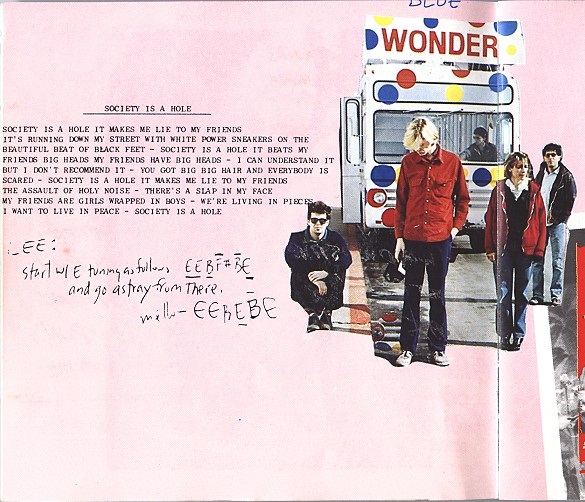
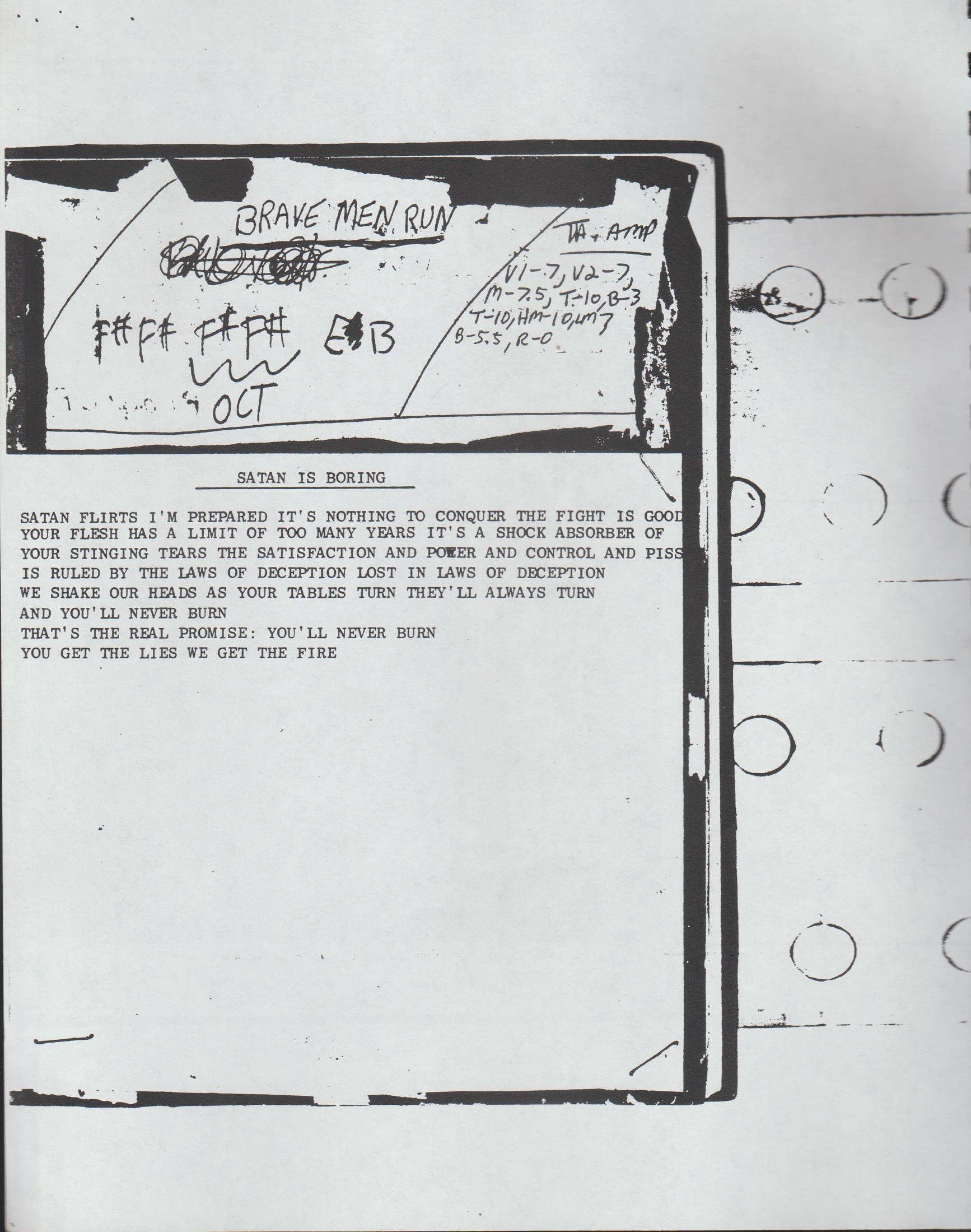
"Society is a Hole" is where I need to start what will be a running thread regarding the tunings listed in the collage style CD liners for Bad Moon Rising. The lyric pages for Thurston's songs are taken from his own journals, and Kim's are handwritten (as is Lydia's draft of "Death Valley"). There are very specific amp settings and tunings for many songs, some scratched out and replaced. It's overall a very cool booklet and a stark contrast to the rather dull one-sided lyric sleeve that comes with the vinyl. Many photographs are overlaid with the lyric pages. (The one for "Society is a Hole" actually got altered when the album was reissued by DGC in the mid 90s - the WONDER bread truck was changed to BOREDOM in Naomi Petersen's awesome shot from LA '85.) In the CD, only Lee's tuning is listed, mysteriously shifting: "start w/ E tuning as follows EEBF#BE and go astray from there. mello - EEBEBE" Thurston's original journal page reveals that his own guitar specs were edited out: Thurston: Knox - anything tuning" followed by 9 knobs of amp settings. Here's the thing - I can practically guarantee from 1984 shows alone that both guitarists are using F#F#F#F#EB, continuing from "Brave Men Run". In fact, I think the first picture from May 19th above, of Lee and Thurston, might even capture them at the end of "Society is a Hole" - Lee playing 19th fret harmonics (before he drops out to start the "Not Right" tape), Thurston cranking out some skronk with a slide over the pick up. The October 24th show seamlessly goes from "Brave Men" to "Society" to "Death". I don't think it's really up for debate.
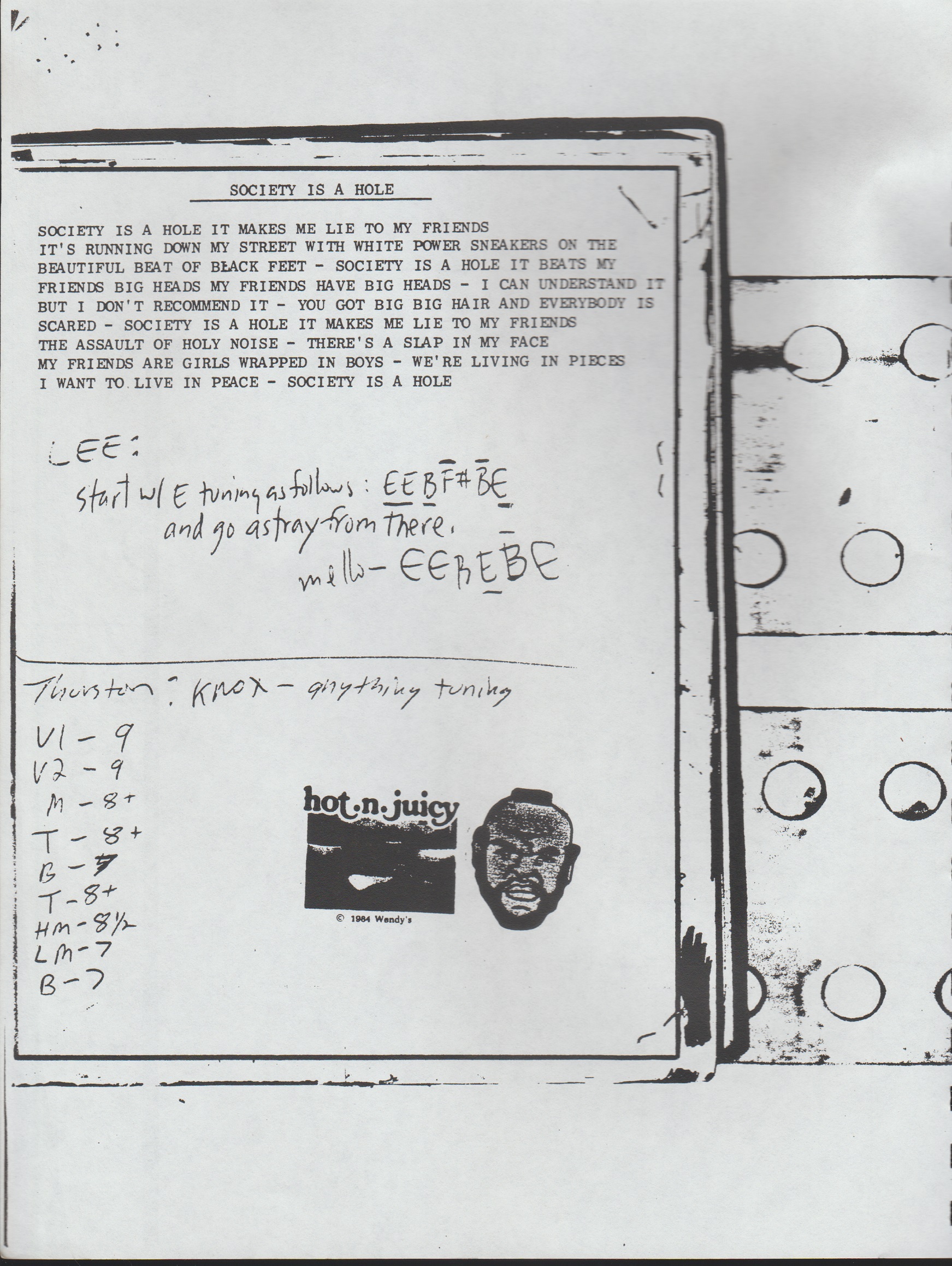
So, what the hell do the notes in the journal mean? They do seem to be deliberately placed with the text for "Society is a Hole", possibly a very early version before they locked in on the F#F#F#F#EB tuning? Maybe? Technically Lee's harmonic riff could be replicated in that EEBF#BE tuning, though I don't know what "mello" would refer to when the song is essentially the same vibe from start to finish. So, I have no answers, just questions, and they won't be the last. Oh, one more - I never really did figure out what the hell Thurston is doing in one of his riffs in this song. He trem picks the B string for a while, then does this weird jerky riff four times, then strums behind the bridge. What's that jerky riff? I've tabbed it as him bending the string, but I feel unfulfilled by that, and I'm wondering if he's bending behind the bridge or using a slide somehow (since I think he uses a slide at the end of the song). Can anyone make sense of it? Is my ear just weak, out of practice? I'll be honest, the tabs aren't going to get a lot better in this series, but I think trying to explain what they were doing is still an interesting endeavour. Until then, thanks for reading, it's nice to be back. I was debating a different idea for a short series, but never felt passionate enough to execute it. One day earlier this month I put on Bad Moon Rising - which I almost never do - and realized I could try to tell its tale over four weeks. I always think of it as a Halloween album, so the fact that next Saturday is the 31st works well. See you then!
As always, if you have any comments or corrections, please let me know!
"INTRO"
LAYOUT
A
KIM
EADG
CENTER
THURSTON
F#F#F#F#EB
LEFT
LEE
F#F#F#F#EB
RIGHT
A SECTION				00:00-00:57

Thurston:

B---0-----------0-------------
E-----0-------0---0-------0---
F#------5---5-------3---3-----   repeat til end
F#--------5-----------5-------
F#----------------------------
F#----------------------------

Lee:

B---0-----------0-------------
E-----0-------0---0-------0---
F#------5---5-------3---3-----   repeat til end
F#--------5-----------5-------
F#----------------------------
F#----------------------------

At 0:17 an overdubbed guitar plays this:

B---------------
E-----------0---
F#--------0----- x 13    (the last 3 are more strums than arpeggios)
F#------0-------
F#----0---------
F#--0-----------

Another overdub plays this:

B------------------
E------------------
F#--9b--------9r---  x 7
F#--9b--------9r---
F#-----------------
F#-----------------

I don't think Kim plays during this song.


text + tab by Chris Lawrence

special thanks to Raj Paden for the main riff!
"BRAVE MEN RUN (IN MY FAMILY)"
LAYOUT
A - B - A - B - C - D
KIM
EADG
CENTER
THURSTON
F#F#F#F#EB
RIGHT
LEE
F#F#F#F#EB
LEFT
A SECTION				00:00-00:29

The riff on the low F# strings is something they can both be seen playing in 1985 footage,
but I can't pick it out of the mix on the album or any live shows. The Brooklyn 2011 release
has clear stereo sound and both guitars can be heard playing something close to this, though
I think they slide to the 12th and back.

Thurston:

B---(0)-------------------------------------------------------
E---(0)-------------------------------------------------------  all open strings are played
F#---5--5-5--5-5--0--0-0--0-0---------------9b-9-9r-9b-9-9r---   incidentally throughout the riff
F#---5--5-5--5-5--0--0-0--0-0---------------9b-9-9r-9b-9-9r---
F#--(0)------------------------0-2\\\10--7--------------------   play 4 times
F#-----------------------------0-2\\\10--7--------------------

Lee:

B---(0)-------------------------------------------------------
E---(0)-------------------------------------------------------  all open strings are played
F#---5--5-5--5-5--0--0-0--0-0---------------9b-9-9r-9b-9-9r---   incidentally throughout the riff
F#---5--5-5--5-5--0--0-0--0-0---------------9b-9-9r-9b-9-9r---
F#--(0)------------------------0-2\\\10--7--------------------   play 4 times
F#-----------------------------0-2\\\10--7--------------------

Kim:

G------------------------------------------
D------------------------------------------
A-----------------------------------7------
E---7--7--7-7-7-7-2--2-2--2-2-2--0-----7---

G-------------------------------------------------------
D-------------------------------------------------------
A---7-7-7--7-7-7---------------------------------7------ x 3
E----------------7--7--7-7-7-7-2--2-2--2-2-2--0-----7---

G----------------
D----------------
A---7-7-7--7-7---
E----------------

B SECTION				00:29-00:43

Thurston:

B----0---0--0---0-0-0-0-0---
E----0---0--0---0-0-0-0-0---
F#---5---5--5---5-6-6-6-6---   x 4
F#---5---5--5---5-5-5-5-5---
F#--------------------------
F#--------------------------

Then:

B-----------------------------------------------
E----3----2-2-2-3---2-2-2-3---2-2-2-3---2-2-2---
F#---1----0-0-0-1---0-0-0-1---0-0-0-1---0-0-0---
F#---0----0-0-0-0---0-0-0-0---0-0-0-0---0-0-0---
F#---0----0-0-0-0---0-0-0-0---0-0-0-0---0-0-0---
F#---0----0-0-0-0---0-0-0-0---0-0-0-0---0-0-0---

Lee:

B----0---0--0---0-0-0-0-0---   x 4
E----0---0--0---0-0-0-0-0---
F#---5---5--5---6-6-6-6-6---  or you can bend the 5th fret
F#---5---5--5---6-6-6-6-6---    instead of going to the 6th
F#--------------------------
F#--------------------------

Then:

B-----------------------------------------------
E----3----2-2-2-3---2-2-2-3---2-2-2-3---2-2-2---
F#---1----0-0-0-1---0-0-0-1---0-0-0-1---0-0-0---
F#---0----0-0-0-0---0-0-0-0---0-0-0-0---0-0-0---
F#---0----0-0-0-0---0-0-0-0---0-0-0-0---0-0-0---
F#---0----0-0-0-0---0-0-0-0---0-0-0-0---0-0-0---

Kim:

G-----------------------------------------
D-----------------------------------------  under first guitar riff
A-----------------------------------------
E---3-3-3-3-3-3-3-3-3-3-3-3-3-3-3-3-3-3---

Then when they switch riffs:

G-----------------------------------------
D-----------------------------------------
A-----------------------------------------
E---0-0-0-0-0-0-0-0-0-0-0-0-0-0-0-0-0-0---

A SECTION				00:43-00:58

Thurston plays his previous riff twice.

Lee strums away at this chord over this entire section:

B--------
E---14---
F#--12---
F#---0---
F#---0---
F#---0---

Kim:

G------------------------------------------
D------------------------------------------
A-----------------------------------7------
E---7--7--7-7-7-7-2--2-2--2-2-2--0-----7---

G-------------------------------------------------------
D-------------------------------------------------------
A---7-7-7--7-7-7---------------------------------7------
E----------------7--7--7-7-7-7-2--2-2--2-2-2--0-----7---

G----------------
D----------------
A---7-7-7--7-7---
E----------------

B SECTION				00:58-01:13

C SECTION				01:13-01:32

Thurston bangs away at the previous section's chords:

B------------
E----2---3---
F#---0---1---  it's pretty buried amongst the noise,
F#---0---0---   listen for the timing if you can
F#---0---0---
F#---0---0---

This section transitions to the verse arpeggiating the chords from "Intro":

B----0---0---
E----0---0---
F#---3---5---
F#---5---5---
F#-----------
F#-----------

Lee:

B----0-0-0-0-0-0-0-0--0-0-0-0-0-0-0-0---
E----0-0-0-0-0-0-0-0--0-0-0-0-0-0-0-0---
F#---5-5-5-5-5-5-5-5--7-7-7-7-7-7-7-7---  back and forth between these chords
F#---5-5-5-5-5-5-5-5--7-7-7-7-7-7-7-7---
F#--------------------------------------
F#--------------------------------------

This section transitions to the verse arpeggiating the chords from "Intro":

B----0---0---
E----0---0---
F#---3---5---
F#---5---5---
F#-----------
F#-----------

Kim:

It sounds like Kim is just mashing the open strings with her hand and pick, you can hear
the D string punching through pretty loud. Just attack that shit!

D SECTION				01:32-03:37

Thurston:

Begin by playing the "Intro" riff:

B---0-----------0-------------
E-----0-------0---0-------0---
F#------5---5-------3---3-----   repeat
F#--------5-----------5-------
F#----------------------------
F#----------------------------

He plays this until Kim sings "I dreamt a sailor's dream at sea" and then he starts
playing harmonics like Lee:

B-------------
E-------------
F#------------
F#-------*7*--  then play another 7th fret harmonic, or strum behind bridge
F#--*5*--*7*--
F#--*5*--*7*--

Around 2:06, he strums behind the bridge and just lightly rattles under the surface
until 2:29 when it almost sounds like he fades in on distorted 12th fret harmonics,
possibly even open string overtones? Then he just strums behind the bridge some more...

At 2:46 he starts strumming between these chords:

B---------------
E---2------3----
F#--0------1----   x 3   then just play the first chord
F#--0------0----
F#--0------0----
F#--0------0----

Lee:

Begin by playing this "Intro" riff:

B---0-----------0-------------
E-----0-------0---0-------0---
F#------5---5-------3---3-----   repeat
F#--------5-----------5-------
F#----------------------------
F#----------------------------

When Kim starts singing Lee plays some harmonic chords:

B---------------                            -------------*7*---
E---------------                            -------------*7*---
F#--*12---*7*---                            --------*7*--------  which he repeats w/ various
F#--*12---*7*---  then a figure like this:  ---*12*-*7*--------   "non" standard harmonics
F#--*12---*7*---                            ---*12*------------
F#--*12---*7*---                            ---*12*------------

His whole part is basically just bashing out harmonics between the 12th and 7th frets, sometimes
adding an odd harmonic like 3rd fret or whatever.

At 2:43 he just starts strumming behind the bridge. Eventually he slows to singular strums, then
fade to METAL MACHINE MUSIC.

Kim repeats this for the rest of the song:

G---------------
D---0-----0-----
A------0--------
E---------------


At 3:19 you can hear the METAL MACHINE MUSIC tape loop start to fade in, which segues into "Society is a
Hole".


text + tab by Chris Lawrence

w/ thanx to Larsen
"SOCIETY IS A HOLE"
LAYOUT
INTRO - A - B - A - B - A - B - A - C
KIM
EADG
CENTER
THURSTON
F#F#F#F#EB
LEFT
LEE
F#F#F#F#EB
RIGHT
INTRO				 	00:00-00:19

The tape loop from "METAL MACHINE MUSIC" plays as a segue from "Brave Men Run".

A SECTION				00:19-01:20

Thurston starts by trem picking the open B string:

B---0-0-0-0-0-0-0-0-0-0-0-0-0-0-0-0-- etc
E------------------------------------
F#-----------------------------------
F#-----------------------------------
F#-----------------------------------
F#-----------------------------------

At 0:43 he starts playing this weird little riff that I can honestly never tab properly:

B--------------1---------
E---2b-2-2r-2b---2b-r2---   it sounds like he's just bending the E string and picking
F#-----------------------    it in various forms of release, but the C note on the B string
F#-----------------------     feels out of place and i wonder if he's bending with the neck
F#-----------------------      itself or something....?
F#-----------------------						play 4 times

At 1:04 he starts strumming behind the bridge, and at 1:10 he's back to trem picking the
open B string.

Lee enters at 0:27 playing 12th fret harmonics:

B-----------------------*12*-------------------------------------*12*--
E-------------------*12*------------------------------------*12*-------
F#--*12*--*12*--*12*----------*12*-*12*-*12*-*12*-*12*-*12*------------ repeat simile
F#---------------------------------------------------------------------
F#---------------------------------------------------------------------
F#---------------------------------------------------------------------

Kim plays:

G------------------------------
D-----------0-0-0----------0---   she repeats this riff through the entire song
A---7-7------------7-7---------
E-------0-0------------0-0-----

B SECTION				01:20-01:48

Thurston trem picks the open B string during the verse.

Lee keps playing his 12th fret harmonic motif. It sounds like he drops out around 1:40 when the
Metal Machine sample gets louder. There are times I think I hear him playing subtle low F#
harmonics but it could be my imagination.

When Thurston sings "Society is a Hole" at 1:47 Kim adds the open G string:

G-----------------------------0---
D-----------0-0-0----------0--0---
A---7-7------------7-7-------(7)--
E-------0-0------------0-0--------

A SECTION				01:48-02:18

Thurston plays the "bendy" riff four times. I still wonder if he's actually using the tuning peg
instead of bending, or bending the open string behind the bridge. It just sounds  so slinky.
I think he uses a slide at the end of the song but I'm not sure how that would work for this riff.

After that he strums behind the bridge again.

At 2:14 he starts trem picking the open B string again.

Around 2:00 you can hear Lee's guitar gradually getting louder, playing harmonics
at the 12th fret of the low F# strings.

Kim plays her main riff, throwing in the open G again at 2:03 and 2:18.

B SECTION				02:18-02:45

Thurston trem picks the open B string during the verse.

Lee plays subtle 12th fret harmonics on the low F# strings until 2:40 when he comes back
in with his previous 12th fret harmonic riff.

Kim plays her main riff, throwing in the open G again at 2:45.

A SECTION				02:45-03:16

Thurston plays his bendy riff x 4, behind the bridge, and back to the B string like previously.

Lee plays his 12th fret harmonic riff through this section.

Kim plays her main riff, throwing in the open G again the first five times.

B SECTION				03:16-03:58

Thurston trem picks the open B string during the verse.

Lee plays his 12th fret harmonic riff through this section. He employs slightly more jagged
picking at points.

Around 3:35 it sounds like he starts playing the 10th fret of the low F# strings. I don't think
it's the open E string although that would be the same note. When Thurston sings "Society
is a Hoooole" he hits a harmonic on the EB strings.

B---------------*12*--
E---------------*12*--
F#---/----------------
F#---/----------------
F#--10----------------  keep picking the 10th fret notes while letting the harmonics ring
F#--10----------------

Kim plays her main riff, throwing in the open G again at 3:21 and 3:31 and 3:42 and 3:52.

A SECTION				03:58-05:17

Thurston uses a slide over where the 24th fret would be to mimic Lee's main harmonic riff.
You can get roughly the same notes from the 5th fret harmonics, they just don't have that
same shakiness that the slide does at the imaginary fret.

B-------------*5*------------------------*5*------
E--------*5*---------------------*5*---------*5*--  (really played with a slide over the 24th fret area)
F#---*5*----------*5*----*5*-*5*-----*5*----------
F#------------------------------------------------  repeat variation
F#------------------------------------------------
F#------------------------------------------------  play til fade

At the start of this section, Lee switches to lightly trem picking the 8th fret on the
F# strings:

B---------                      ------                     -----
E---------                      ------                     -----
F#---/----                      ---/--                     --/--
F#---8----  at 4:09 switch to:  --10--   at 4:19 back to:  --8--
F#---8----                      --10--                     --8--
F#---8----                      --10--                     --8--

At 4:29 he starts playing his first motif as 7th fret harmonics:

B---------------------*7*----------------
E-----------------*7*---------------*7*--
F#--*7*--*7*--*7*-----------*7*-*7*------ then it tapers off and he just starts strumming
F#---------------------------------------  harmonics at the 7th fret of the middle strings
F#---------------------------------------
F#---------------------------------------

He could also be playing these as 19th fret harmonics.

Fade out when the "NOT RIGHT" sample enters.

Kim plays her main riff, throwing in the open G again the first four times, once without, once with,
and then fades out.

C SECTION				05:17-05:58

A tape of "NOT RIGHT" by the Stooges, which was chopped up by Lee, plays while "Society" fades
to bridge to "I Love Her All The Time". During live performances of the BAD MOON RISING suite,
they would play a tape of the full "Not Right" while switching guitars.


text + tab by Chris Lawrence
Return to the Sonic Youth Guitar/Bass Tab Archive